
Author: Dr Peter Laight
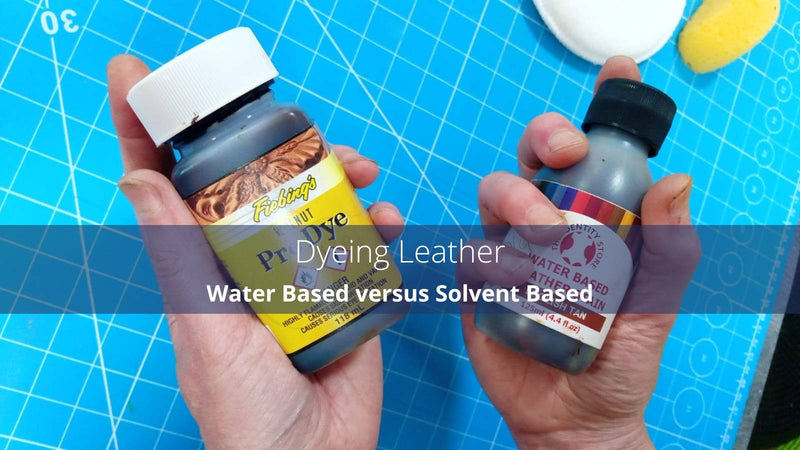
Have you ever wondered about the different types of dyes and pigment stains? Why some are dissolved in solvent and others in water?
What are the different properties of the leather during and after dyeing?
This email deals with the water versus solvent question, in the following email we will look at dyes versus stains.
Dyes used in leathercraft have been developed to predominantly colour vegetable tanned leather, although the stronger more aggressive types work also on chrome leather.
Modern dyes and pigments are synthetic chemicals developed over the past 100 years. All are based on carbon in various formations with significantly different structures and reaction groups. All have to be dissolved and suspended in liquid for application to the leather. In most cases this is done by the dye manufacturers although powder dyes can still be obtained and are used by
Most craft dyes are sold in small 115 or 125ml or 1 litre bottles, with the dye or stain ready to be applied directly or to the leather by padding or spraying.
Types of Dye and Pigment
There are over ten different chemicals structures of dye, each developed for different purposes and materials. The following are predominantly used in leather dyeing:
|
Category |
Used in: |
Solvent used: |
|
C1 Basic Dyes |
Fiebing’s Leather Dyes |
Solvent Based –2-(2-ethoxyethoxy) ethanol, ethanol, isopropanol
|
|
C1 Solvent Dyes |
Fiebing’s Pro Dyes |
Denatured alcohol, isopropanol, xylene, 2-(2-ethoxyethoxy)
|
|
Acid Dyes |
Tandy Eco-Flo Leather Dyes |
De-ionised water
|
|
C1 Pigment (various colours) |
Identity Water Based Leather Stains |
De-ionised water, vinyl acrylic co-polymer, propylene glycol
|
In this article we are concentrating on the differences between water and organic solvent use. Other differences can be caused by type of dye stuff and pre and post application treatments.
On application by dabbing/spraying the liquid both penetrates and ‘reacts’ with the leather. The amount and evenness of application influencing both levelness and penetration. Organic solvents have the ability to disperse fats on the surface or slightly beneath. This can aid penetration specifically of dyestuffs. Levelness and penetration are also influenced by the PH of the leather. This is largely ignored in veg craft applications as the variations in PH are not judged as significant. (More of this in articles to follow.)
The reaction of the dyestuff molecule with the leather fibre also depends on how quickly the fibre “wets”; a solvent medium can enhance this endeavour. There is the danger of reacting too quickly before the spreading has occurred, which can cause unevenness. Experimentation is necessary to compare results.
- As a generalisation solvent can enhance reactivity and depth of shade, although this is not easy to differentiate from the effect of type of dye stuff.
- Solvent evaporates more quickly causing more rapid drying.
- The bond strength of the dye with the leather fibre is largely independent on the dissolving medium, so water-based dyes have satisfactory fastness properties.
- Solvent based dyes have higher VOC (volatile organic compounds) than water-based dyes making their environmental impact higher.
- Solvent based dyes can be less pleasant to use than water-based dyes, in particular they should be used in a well-ventilated room.
- Water based dyes are less likely to move the fat from the leather so won’t cause hardening or cracking if the leather they are applied to has this tendency.
- It is easier to clean applicators and containers after water-based dyes have been used.
- Solvent based dyes, although not recommended for the purpose, can dye resin finished leathers without removing the finish first, with care they can be used to re-dye shoes, coats, and furniture leather. If you are unsure, please consult an experienced leather dyer first.




Forgot to mention that I worked on a line of superior leather care products for a Texas company. Thanks again.
What’s the composition of Fiebing’s Tan-Kote? I read the MSDS and saw only borax listed. I’m a cosmetic chemist and rancher, DIYer and wooden boat builder. I’ve used lots of gums & resins in skin care and woodworking and other products. Thanks
. "Wow, what an eye-opening read! I’m grateful for stumbling upon your blog. Your expertise shines through your writing. it will be helpful in finding fine leather quality . If you’re hungry for more valuable insights of top branded jackets make sure to visit our varsity jackets . It’s a treasure trove of fashion and heritage.
Thanks for your blog post for dyes. https://www.dyespigments.net/solvent-dyes-manufacturer-supplier-exporter-india.html